18 Aug, 2026
Author: Anukriti Kotwal, Team SA-SNALC
________________________________________________________________
“Can we truly achieve equitable skilling if we focus only on training, curricula, employability, and placement without addressing the deep-rooted social norms that shape aspirations, choices, opportunities, and long-term participation in the workforce?”
-Ritu Kharayat, PCI India
Marking UNESCO’s World Youth Skills Day, on 15th July 2026 South Asia Social Norms Agency Learning Collaborative (SA-SNALC) hosted its webinar, “Norm Shifting as a Pathway for Equitable Skilling.” Moderated by Ms. Shahnoor Akter Chowdhury; a feminist scholar-practitioner, senior gender expert, and anthropologist with over 20+ years of experience, the panel brought together key voices from the domain of skilling and social norms, Ishanee Bhattacharyya from Quest Alliance, Shreya Agarwal from Pratham, and Sruthi Niveditha Kande from PCI India.
While standard skilling discourse centers on the number of training programs conducted, youth enrolled and certified, placement rates, admissions, and overall employment outcomes. This session shifted the attention to a deeper, more fundamental question: “Who gets to choose their future in the first place, and how are those choices shaped?” Do social norms and normative factors influence or shape these choices in deciding who can access, complete, and benefit from the skilling opportunities? Social norms are the unwritten rules that stand unimposed but long before a young person steps into real life, their career path has already been filtered through what their community considers typical and appropriate.
How do Social Norms Puppeteer Behavior
Descriptive norms, injunctive norms, reference groups and sanctions
Our expert panel highlighted some barriers and gatekeepers, mentioned below:
One key learning is that centers like Industrial Training Institutes (ITIs) also fall within the ambit of societal norms. These norms do not end at the entry gates of these learning centers, they are carried by the students, the trainers, and the counselors in various ways. Counselling for women may be targeted towards certain career choices that are seen to be “fit” based on their gender identity. These biases snowball and get perpetuated from that point onwards into professional lives as well. These influences are captured well by the theory of planned behaviour given by Icek Ajzen (1985) (Figure 1)
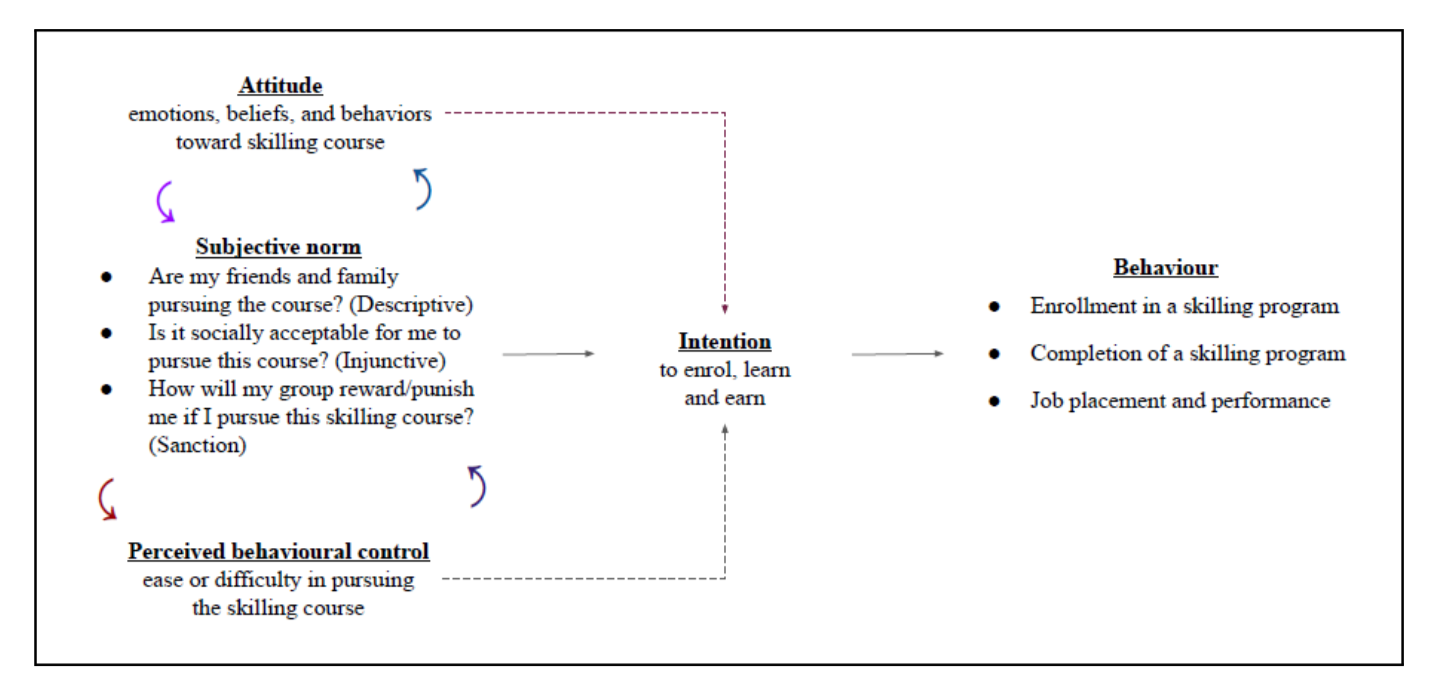 Source: Presentation by Vineha Tatkar, SA-SNALC on 21st July, 2026 in ‘Norms Shifting as a Pathway for Skilling’
Strategies to Shift Restrictions Posed by Social Norms for Equitable Skilling:
In order to shift social norms, it is important to work across individual, interpersonal, organisational and community levels, working with individuals and reference groups to ensure that key influencers support change and a new norm is created in the space of skilling of youth.
The panelists shared real life, field-tested solutions that aim at breaking restrictive patterns in youth skilling and employability caused by social norms. These can be described mainly in three ways:
Rigid definitions of traditional vs non-traditional work can be highly restrictive for individual freedom of choosing their career pathways and economic empowerment. Choice gets compromised when societal expectations force the youth to pick from predefined options. The Q&A session was resonant with this idea. Equitable skilling is not only about filling seats in training centres and expanding the reach in the number of courses available, but it is also about agency in the choice of careers, quality training, and balancing the aspirations of the youth with the opportunities available; these are the goals that must be forefronted instead of predefined skilling programs and placements based on prevalent social and gender norms.
Watch the full webinar here: https://socialnormscollaborative.net/events/webinar/norms-shifting-as-a-pathway-for-equitable-skilling/
Featured Image Creator: C.V.Subrahmanyam | Credit: THG Publishing Private Limited